
Downforce explained: why an F1 car could drive upside down
It is F1's most repeated fact: a grand prix car makes so much downforce it could drive along the roof of a tunnel. The physics says yes, in principle. The engineering says it is far harder than the pub version suggests.
Wings that fly the wrong way
"Downforce is a vertical aerodynamic force that pushes down on the car, to generate more grip and go faster through corners," McLaren aerodynamics specialist Emel Cankaya explained on Formula1.com's F1 Explains podcast. The wings work like an aircraft wing mounted upside down: instead of lifting the car, they press it into the track.
They follow the same rule as lift. NASA's lift equation multiplies a lift coefficient, which captures the wing's shape and angle, by half the air density, the wing area and the square of the speed. Double the speed and you get four times the force, which is why downforce counts for far more in fast corners than slow ones. Mercedes says an F1 car pulled more than 5g at the apex of Suzuka's first corner, taken at over 260km/h, the highest cornering load of the 2024 calendar. That is only possible because the air is pressing the tyres down far harder than the car's own weight could.
The floor does the heavy lifting
Much of the real work happens underneath. The floor behaves like a Venturi tube: air enters at the front, speeds up through the narrow gap under the car, then expands up the diffuser at the back. Faster air means lower pressure, and lower pressure beneath the car than above it means downforce. Raceteq's aerodynamics explainer calls the rear diffuser "the most efficient aerodynamic component on most cars", because it can make a lot of downforce for little drag.
The idea is not new. In the 1970s Lotus used skirts to seal the gap between floor and track, and Brabham's BT46B used a fan to suck air out from underneath. Niki Lauda won the 1978 Swedish Grand Prix in it before Brabham withdrew the car. Ground-effect floors returned to F1 in 2022.
So could it really drive on the ceiling?
Teams guard their downforce figures closely. Raceteq says an F1 car at top speed can generate four times its weight in downforce. Take that at face value and the square law does the rest: four times its weight at top speed means roughly its own weight at half that speed. That is back-of-the-envelope arithmetic, not a measurement; a PlanetF1 feature on the question puts the crossover at around 200km/h.
Upside down, gravity changes sides. On a ceiling, the force pressing the tyres into the surface is the downforce minus the car's weight. At the crossover speed that is zero, so the car would hang there with no grip, unable to steer, brake or accelerate. To drive rather than merely cling on, it would need to be going well above that speed.
There are practical problems, too. You would have to get up there first; BBC Science Focus suggests driving through a tunnel and gradually steering up the sides until you were "motoring along the roof". And the engine is not built to run inverted. As PlanetF1 points out, its lubrication and fuel systems rely on gravity. So the claim survives, with conditions. As far as we can find, nobody has tried it in an F1 car.
Did you know?The first car to drive upside down was not an F1 car. In April 2025 McMurtry Automotive turned its Spéirling Pure fan car over on a rotating rig and drove it a short distance at low speed. Its fans spin at 23,000rpm and create the equivalent of 2,000kg of downforce with the car standing still: Brabham's 1978 trick, updated.
The price of grip
Downforce is never free: the wings that push the car down also hold it back. "If a car spends a lot of time on straights, like in Monza, you need low drag," Cankaya said. "Drag slows you down, so you want a small rear wing. But in Monaco, where you have a lot of low-speed corners, to go as fast through the corners, you would want a large rear wing." Push a wing too far and the airflow breaks away: the wing stalls, suddenly losing downforce and drag.
Porpoising: when the floor bites back
Ground effect brought an old problem back in 2022. As speed rises the floor is sucked closer to the track, the air rushes faster through the shrinking gap and the suction grows, until the flow stalls. The load vanishes, the car springs up and the cycle repeats. Mark Hughes described it for Formula1.com as "a violent bouncing on the suspension at high speeds", and none of the teams had seen it in simulation. The FIA brought in a metric for vertical oscillation mid-season, then for 2023 raised the floor edges by 15mm and part of the diffuser by 10mm.
2026: less of everything, and wings that move
When the FIA unveiled this year's rules in June 2024, it targeted 30% less downforce and 55% less drag. The cars are smaller: maximum wheelbase down 200mm to 3,400mm, width down 100mm to 1,900mm, floor 150mm narrower. A partially flat floor and a less powerful diffuser are meant to reduce ground effect and the need to run the cars ultra-stiff and low.
The novelty is active aerodynamics. Under the 2026 technical regulations the front and rear wing flaps each have two fixed positions. Corner Mode is the default. Straight Mode reduces the flap angle to cut drag, and the driver can select it when the system is enabled in FIA-defined activation zones. The switch must take no more than 400 milliseconds, a failure sends the wings back to Corner Mode, and in low-grip conditions only the front wing may open. Overtake Mode, extra electrical power for a car close behind, is a separate system.
Has downforce really fallen by 30%? Nobody outside the teams can say for sure: they do not publish their numbers, and that figure was a target set two years before the cars ran.
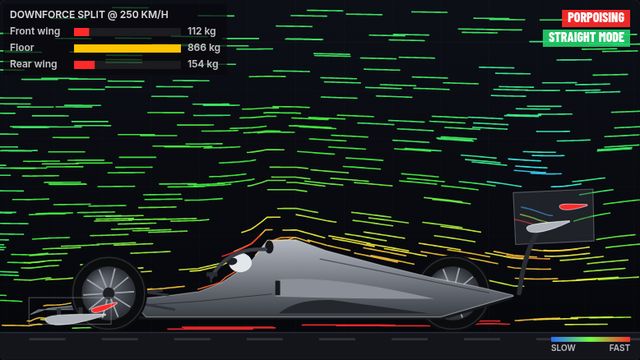
Try itOur Aero Lab is a wind tunnel in your browser, a lattice Boltzmann simulation that computes the airflow in real time. It is a simplified 2D teaching model, a long way from a team's 3D CFD, but you can change the wings, ride height and active-aero flaps and watch the flow respond.
Sources: Formula1.com, F1 Explains: downforce, with McLaren's Emel Cankaya (October 2024), "What is porpoising" (Mark Hughes, February 2022), FIA unveils 2026 regulations and 2026 aerodynamic regulations explained (June 2024); FIA 2026 Technical Regulations (Issue 20, Articles C3.10.10 and C3.11.6) and 2026 Sporting Regulations (Issue 9, Article B7.1); NASA Glenn Research Center, the lift coefficient; Raceteq, "Motorsport aerodynamics explained" (October 2024); Mercedes-AMG F1, "G-force and Formula One: Explained"; Motorsport.com, outlawed F1 innovations; PlanetF1, "Can an F1 car drive upside down?"; BBC Science Focus, driving on the roof of a tunnel; TechRadar on the McMurtry Spéirling (April 2025); The Race, 2023 technical rule changes. Facts checked on 14 October 2026.
Comments
Comment rulesHouse rulesBe respectful: no personal attacks, no spam. Comments are public and we moderate them. Read the rules
Loading comments…