
How fast do F1 drivers react at the start?
Five red lights, a pause nobody can predict, then darkness. The start of a grand prix tests every driver's reflexes against the same signal at the same instant, and some of the most famous numbers are not really reactions at all.
Light by light
After the formation lap the cars stop in their grid slots with engines running. In 2026 the procedure gained a new first step: the grid light panels flash blue for five seconds and "Pre-Start" appears on the gantry. Then the five red lights come on, one per second. How long they stay lit after the fifth is entirely up to the permanent starter. There is no rhythm to learn, and that is the point.
The blue phase exists because of this year's engines. Without the MGU-H, which used to keep the turbocharger spinning, the 2026 power units suffer from turbo lag, and drivers need time to build revs. After drivers struggled with practice starts in pre-season testing, the FIA trialled the warning in Bahrain and kept it. "I think the five seconds are an established process now, I don't see why it would change in this regulation cycle," FIA single-seater director Nikolas Tombazis said in August, as reported by PlanetF1, citing Motorsport.com.
What counts as a jump start
Article B5.11.1 of the 2026 sporting regulations is short. Every car must be stationary in its grid slot from the moment the third red light comes on until the lights go out, positioned so the FIA timing transponder can detect the instant it first moves, with its front tyres inside the box. The stewards choose the punishment: a five-second penalty, a ten-second penalty, a drive-through or a stop-and-go.
For years the transponder effectively had the final word. At Suzuka in 2019 Sebastian Vettel's Ferrari twitched forward on pole and stopped again, and the stewards ruled the movement "within the acceptable tolerance of the F1 jump start system". That tolerance exists because drivers sometimes adjust the clutch in the final moments. In Jeddah in 2024 Lando Norris visibly lurched, but the rules of the day said a jump start was judged "in accordance with the transponder", and it had not registered one.
The 2026 rulebook does not repeat that line. At the British Grand Prix in July, Lewis Hamilton got five seconds after the stewards reviewed "video, timing and in-car video evidence" and saw the yellow Pirelli lettering on his tyre roll forward before the lights went out. "The fact that the movement was limited does not negate the infringement," their decision said.
The 0.2-second wall
Humans are not especially quick. The accepted average for a simple reaction to a light among college-age adults is about 190 milliseconds, against about 160 for a sound, as a 2015 paper by Aditya Jain and colleagues sets out. One reason, the paper notes, is that a sound reaches the brain in 8 to 10 milliseconds and a visual signal in 20 to 40.
Athletics draws a hard line under that. When a certified start information system is in use, World Athletics' rules say it flags a possible false start whenever a reaction time is under 0.100 seconds, on the assumption that nobody genuinely reacts to the gun faster. Even that is a convention rather than a law of nature: in a 2007 study, Matthew Pain and Angela Hibbs found five of their nine athletes averaged under 100 milliseconds in at least one test condition.
Formula 1 has no equivalent floor. It treats anticipation as a gamble. "For us it's not like athletics," the FIA's Charlie Whiting told Auto Motor und Sport in 2014, after Lewis Hamilton was credited with a 0.05-second reaction at Monza. "We proceed on the basis that anyone who tries to anticipate the start takes the risk of incurring a penalty. But if he does take the risk and takes off just as the lights go out, he's lucky."
What the drivers actually manage
The best-known modern example came at the 2017 Austrian Grand Prix. When Valtteri Bottas won it, his reaction was quoted at 0.201 in the FIA press conference, and his transponder data showed he had stayed within the tolerance. Vettel, who had questioned the start over the radio, still found it hard to believe. "I think the reaction times are around 0.2s for everyone," he said. Daniel Ricciardo reckoned Bottas had anticipated and got lucky: "The lights were held for a long time, more than normal."
Two years later at Suzuka, Bottas said his reaction was "four-hundredths", measured to his first movement of the clutch paddle, and admitted the risk: "normally it's at least a tenth your reaction time." Figures like 0.04 or 0.05 seconds are not reflexes in any biological sense. They are well-timed guesses that landed on the right side of the line.
Launching a 2026 car
Seeing the lights go out is only the trigger. The 2026 technical regulations say clutch engagement must be "controlled solely and directly by the driver", with narrow exceptions such as stall prevention and a bite-point finder, and any system designed to detect the start signal is banned. In 2016 the FIA limited drivers to one hand on a single-paddle clutch for starts, and the launch remains a matter of feel: too little clutch and the car bogs down, too much and the rear tyres spin.
This year's cars add two complications. Turbo lag means holding the revs up for longer before letting the clutch go. And the electric motor cannot help off the line: the MGU-K may only drive the car once it reaches 50km/h at a standing start, unless the FIA's standard ECU steps in to maintain a minimum acceleration. That safety net arrived after slow getaways caused some hairy moments early in the season, most notably in Melbourne. Tombazis called it "emergency recovery, so electrical parts to help recover a car that has a very slow start".
A great start, then, is a reaction near the human limit and a clutch release on the edge of wheelspin. Guess a few hundredths early and the stewards will be in touch.
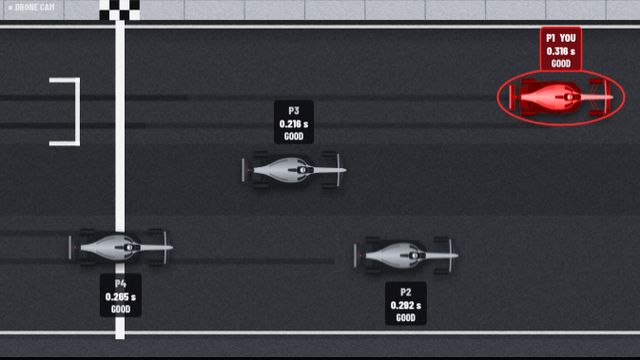
Try itLights Out uses the real rhythm: five red lights, one per second, then a random hold. It marks anything under 0.100 seconds as anticipation, as athletics would, and a jump start scores nothing. Times include your screen and input lag, so a fast monitor helps.
Sources: FIA 2026 Sporting Regulations (Issue 9, Articles B5.7.2 and B5.11.1) and 2026 Technical Regulations (Issue 20, Articles C5.2.12, C8.3 and C9.2.5); Formula1.com, "Why race starts will be different in 2026" (Mark Hughes, March 2026) and "The single-clutch race start returns" (2016); PlanetF1, on the five-second warning (August 2026); Motorsport.com on Vettel's Suzuka 2019 start and Bottas's 0.04s reaction; Crash.net on Norris in Jeddah 2024; F1technical on Hamilton's 2026 British GP penalty; ESPN on Bottas's Austria 2017 start; Auto123 (via GMM) on Whiting and anticipation; Jain et al., International Journal of Applied and Basic Medical Research (2015); Pain and Hibbs, Journal of Sports Sciences (2007); World Athletics Technical Rules (false start). Facts checked on 14 October 2026.
Comments
Comment rulesHouse rulesBe respectful: no personal attacks, no spam. Comments are public and we moderate them. Read the rules
Loading comments…