
Inside a two-second pit stop
A car arrives at pit-lane speed, a couple of dozen people pounce, and about two seconds later it is gone on four fresh tyres. Done well, a stop barely registers on television. Done badly, it can cost a race, a fine or, at worst, a mechanic a broken leg.
Who does what
The sporting regulations do not fix the size of a pit crew. When Formula1.com went behind the scenes with Williams in 2019, the team ran a 23-strong crew, each member with one job that never changed.
The front jack operator stands in the car's path and takes the nose on a carbon-fibre jack, soaking up its momentum while lifting. The rear jack operator runs in behind, and tends to be one of the strongest in the team because the low cars offer little leverage. Each corner has a gunner, one person to pull the old wheel off and another to fit the new one. Two more hold the car steady, two adjust the front-wing flap, and spares stand by with a backup jack and fire extinguishers. Running the release lights is usually the chief mechanic. All of them are the team's own mechanics and technicians, not hired specialists.
Two seconds, frame by frame
The DHL Fastest Pit Stop Award times the car while it is stationary. Formula1.com's breakdown of a solid 2.2-second stop runs like this: front jack fully engaged at 0.3 seconds, rear up by 0.4, old wheels off at around 0.6 and new ones on at 1.2. By 1.4 the guns have reversed and are back on the nut. At about 1.9 they come off and each gunner presses a button to confirm the wheel is tight, and at roughly 2.1 the jacks drop.
The front gunners can lean onto their wheels before the car has fully stopped. The rear gunners cannot: the rear wheels are dished, with the nut recessed, so they wait until the car is still. Once the buttons are pressed, the car should go at once. "If there's a half a second delay, you know something has gone wrong," Williams gunner Chris Stafford told Formula1.com in 2019.
Guns, nuts and lights
The technical regulations require a single fastener per wheel. The nut is captive, staying with the wheel, and the gunner holds down spring-loaded retaining clips until the old wheel is clear of the axle. The 2026 rules also demand a two-stage device that keeps hold of the nut if it works loose, plus a way for the crew to spot an incorrectly fitted nut by eye. The guns may only be powered by compressed air, nitrogen or electricity; Formula1.com put their working pressure at 26 bar in 2019.
The lollipop is long gone, replaced by traffic lights, but a human still makes the call, watching the gunners' confirmation lights and the pit lane. Teams fix a marker to the pit-wall guardrail upstream of their box, and if another car is already past it, the light stays red.
Keeping a human in the loop is deliberate. In 2021 the FIA cracked down on suspected automation, citing the rule that sensor systems "may only act passively", wording still in the 2026 regulations.
Did you know?Front jacks can cost around £250,000 each, and teams need at least two, according to Formula1.com. Wheel guns are about £5,000 off the shelf, but every team modifies them, roughly doubling the price, and they need 24.
Practice, but not too much
Before the 2019 season Williams did just over 1,200 practice stops on a rig at Grove. When the team let everyone have a go at Silverstone, they quickly got down to three seconds, team manager Dave Redding said, "but going from three to two is like going from Division 4 to Premier League!"
At the track the aim is staying sharp: eight or ten stops a session, rarely more, for fear of leaving the crew tired or jaded. McLaren set the world record on a weekend when it had cut back practice to spare its crew the heat.
When it goes wrong
The rulebook treats unsafe releases two ways. Sending a car out where it endangers people or risks a collision is one offence. Releasing it in an unsafe condition, typically with a wheel not properly attached, is another, and in a race it brings a stop-and-go: ten seconds sitting in the box. Liam Lawson got one in Abu Dhabi in 2024 when his front-left wheel was not fastened correctly. Oliver Bearman's Haas got the same in Qatar last year after rolling forward with the left-rear wheel not attached.
The worst case is a person in the way. At the 2018 Bahrain Grand Prix, Kimi Raikkonen's Ferrari got a green light while the left-rear wheel was still being changed. He pulled away and knocked down mechanic Francesco Cigarini, who suffered a double leg fracture. Ferrari blamed a sensor and were fined €50,000.
Then there is the nut that will not come off. At Monaco in 2021, Valtteri Bottas pitted from second and never rejoined: the gun had not engaged squarely and ground away the front-right nut's driving faces. "We call it machining of the nut," explained Mercedes technical director James Allison. A nut that goes on crooked or cross-threaded is the other classic fault, and the 2026 rules require a bad fitting to be visible to the crew.
The record, and a slower 2026
The world record is 1.80 seconds, set by McLaren for Lando Norris on lap 27 of the Qatar Grand Prix on 8 October 2023. It beat Red Bull's 1.82 for Max Verstappen in Brazil in 2019, and Guinness World Records recognises it.
Nobody has threatened it this year. Through Singapore, Formula 1's official DHL table shows the quickest 2026 stop as 1.99 seconds, by Racing Bulls in Hungary, with Ferrari's 2.00 in Japan next. Last season McLaren's best was 1.91. We have not seen a convincing explanation for the slower times, so we will not invent one. And the stationary time is a small slice of the cost: at the Hungaroring, Racing Bulls' cars spent 21.4 to 21.9 seconds in the pit lane per stop, according to F1's pit-stop summary.
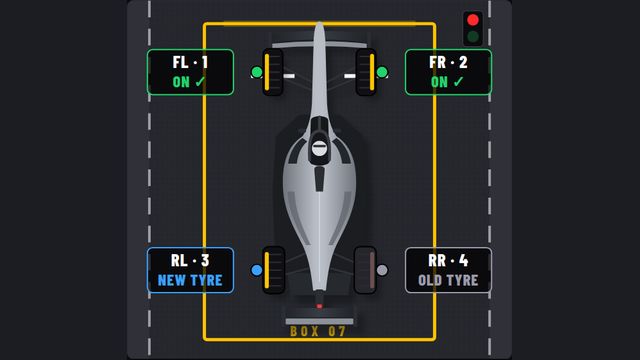
Try itIn our Pit Stop Challenge the clock starts when the car stops on its marks: jack it up, gun off, swap, gun on, drop and go. See how close you get to two seconds, and don't drop the car with a wheel missing.
Sources: Formula1.com, "Anatomy of a pit stop" (Matt Youson, March 2025) and "Gone in 1.88s" (Lawrence Barretto, October 2019); FIA 2026 Sporting Regulations (Issue 9, Articles B1.6 and B1.9.5) and 2026 Technical Regulations (Issue 20, Article C10.9); FIA stewards' decisions, Abu Dhabi 2024, car 30 and Qatar 2025, car 87; Motorsport.com, "How F1 teams have pushed the boundaries with pitstops" (July 2021); Formula1.com, Ferrari's explanation of the Bahrain 2018 error; The Race, on Bottas's Monaco 2021 wheelnut; Guinness World Records and Top Gear on the 1.80s record; Formula1.com DHL Fastest Pit Stop tables for 2026 and 2025; Formula1.com 2026 Hungarian GP pit-stop summary. Facts checked on 14 October 2026.
Comments
Comment rulesHouse rulesBe respectful: no personal attacks, no spam. Comments are public and we moderate them. Read the rules
Loading comments…